Rice and histamine: The role of rice in a low-histamine diet
Rice is one of the most popular grains worldwide and is available in many different forms. If you'd like to learn more about the versatility of rice, the different varieties , and its suitability for a low-histamine diet , you should definitely read the following blog article.
Origin, taste and numerous varieties
In terms of taste, it is pleasantly neutral , but some varieties also taste nutty and spicy .
There are thousands of different rice varieties worldwide. Broadly speaking, they are categorized as short-grain, medium-grain, and long-grain rice. Rice is also distinguished by its degree of processing. The main categories are white rice, brown rice, and parboiled rice . Brown rice undergoes the least processing , meaning that the rice is not processed beyond the removal of the husk. Therefore, it contains significantly more fiber, vitamins, and trace elements than conventional rice. With white rice, on the other hand, the bran layer is removed and the grains are polished. While this makes it last longer, it also results in a significantly lower nutrient content. The parboiling process has the advantage of pressing the bran layer of the grain into the interior. This preserves some of the vitamins, but the grains no longer contain any fiber after the process.
Some of the most well-known rice varieties include:
- Rice pudding – This is made from milled and polished round-grain rice. However, many vitamins and nutrients are lost during this process.
- Basmati rice – one of the finest varieties of long-grain rice worldwide. As white rice, the grains undergo three to four milling processes, during which the bran and the fatty germ are removed.
- Brown rice – whole grain rice from which only the outer, indigestible husk has been removed, but not the outer layers of the rice grain. It still contains all its nutrients and has an intense, nutty aroma.
- Long grain rice – This rice is usually at least 6 mm long and remains loose and grainy even when cooked.
- Wild rice – Strictly speaking, wild rice isn't rice at all, as it consists of the seeds of a type of sweet grass. Black wild rice, which originates from Canada, has a very intense flavor and is extremely rare. Therefore, it is also more expensive than other rice varieties.
The importance of rice in a low-histamine diet
Rice is suitable for:
- low-histamine diet
- gluten-free diet
- lactose-free diet
- low-fructose diet
- low-sorbitol diet
- low-salicylate diet
- low-nickel diet
How to prepare rice correctly for histamine-sensitive people
Since, as described above, many rice varieties are contaminated with arsenic, mineral oil, or traces of pesticides , you should make sure to wash the rice thoroughly. To do this, place the rice in a bowl of water before cooking and wash it carefully with your hands. The excess starch will cloud the water. You can simply pour off the cloudy water and repeat this process until the water runs clear . After that, you can cook and enjoy the rice without any problems.
Proper storage of rice
Depending on the type of rice, uncooked rice can easily be stored for one to three years . However, for those following a low-histamine diet, it shouldn't be stored for too long, as it is more easily tolerated the fresher it is . To guarantee the longest possible shelf life, uncooked rice should be stored in a dark, dry, and airtight container.
Once cooked , rice should only be stored for a short time , about a day in an airtight container in the refrigerator. Cooked rice is highly perishable and its moisture provides an ideal breeding ground for bacteria.
Delicious low-histamine recipes with rice
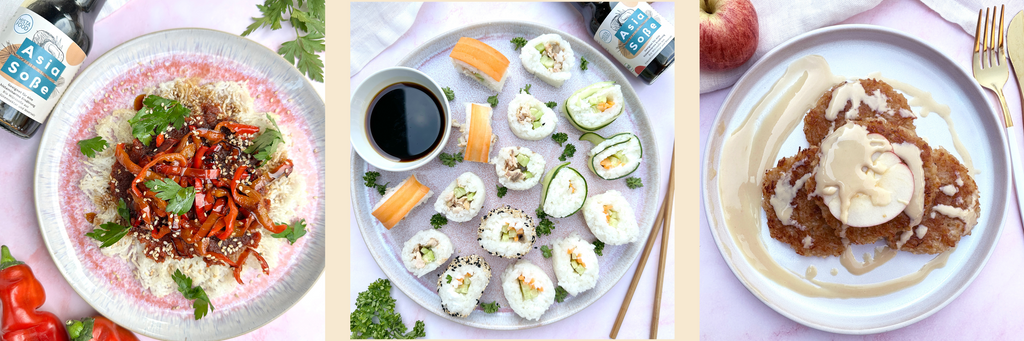
Homemade Asian rice cakes:
The recipe is: low-histamine, gluten-free, lactose-free, vegan.
You will need the following ingredients:
- Basmati rice
- HistaFood Organic Vegetable Spread
- Pointed peppers
- Olive oil
- HistaFood Organic Asian Sauce
- Sesame (1)
- Salt
- some parsley
Low-histamine sushi:
The recipe is: low in histamine, gluten-free, low in fructose
You will need the following ingredients:
- Sushi rice
- Cucumber
- carrot
- Oat cream cheese (1)
- Wild salmon fillet
- HistaFood Organic Asian Sauce
- Sesame (1) or black cumin
- Olive oil
- cling film
- Sushi mat
You absolutely have to try it!
Vegan apple and rice fritters:
The recipe is: low-histamine, gluten-free, lactose-free, vegan
You will need the following ingredients:
- Basmati rice
- Rice pudding
- Coconut blossom sugar
- Water
- apples
- Cornstarch
- coconut oil
- applesauce or almond butter (1)
You might like these products
=== PRODUCT LIST PRODUCTS ===
Sources
- https://eatsmarter.de/lexikon/warenkunde/getreide/reis
- https://eatsmarter.de/lexikon/warenkunde/getreide/wildreis
- The Great Encyclopedia of Food, 1998 Südwest Verlag GmbH & Co. KG


